
How to Start a Tarot Journal You'll Actually Want to Keep
A five-line entry you can write in two minutes, how to spot the cards that keep coming back, and what to do when you read old pages.
Most tarot journals die the same way. The first entry is three pages long, with the moon phase, a drawing of the spread and a paragraph on every card. The second entry is a page. By the end of the second week the notebook is in a drawer. The ambition that made the first entry beautiful is exactly what made the habit impossible.
A journal you keep is worth more than a journal you admire. This guide starts with the smallest entry that is still useful, then shows what a journal gives back after a few weeks: the cards that repeat, the readings that only made sense later, and a vocabulary of meanings that is yours rather than the guidebook's.
If you like paper, our free printable tarot journal templates give you a daily card page, a three-card reading page and a month-in-cards tracker, ready to print.
Why bother writing it down
Three reasons, in rough order of how quickly you'll notice them.
Memory is selective. It is easy to remember the readings that seemed uncanny and forget the rest. Written entries show you what you actually drew and what you actually thought it meant, which is far more useful than a vague sense that tarot is or isn't "accurate".
Meaning arrives late. A card that seemed off on the day often makes sense later in the week. Without a note, you won't remember which card it was.
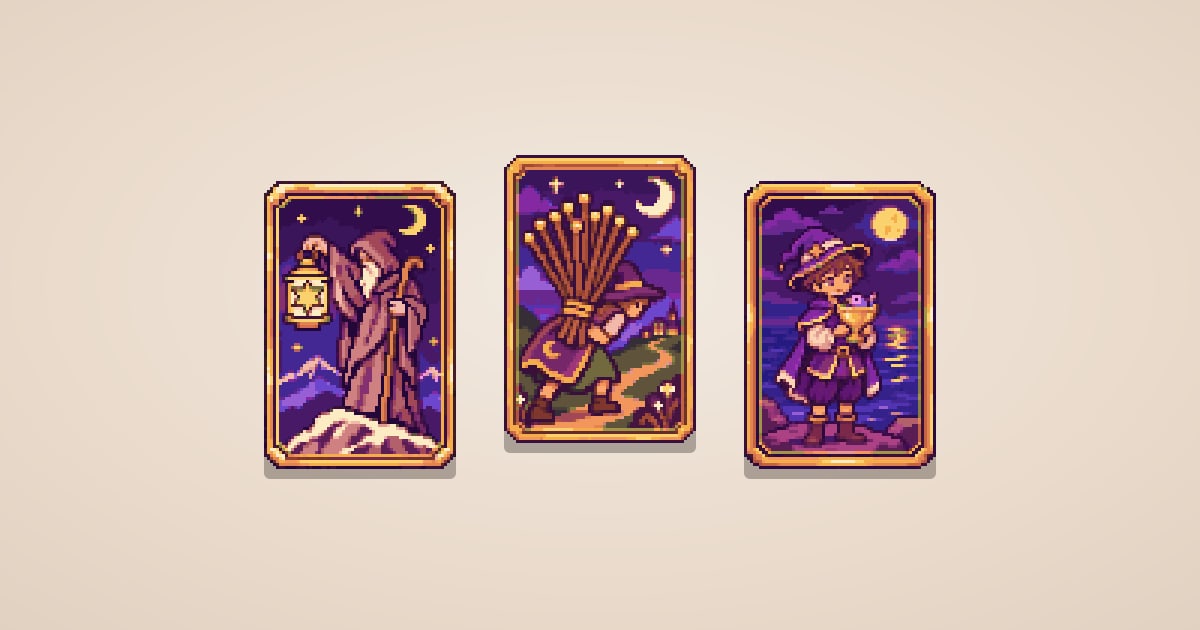
You build your own dictionary. A guidebook says the Ten of Wands, a figure bent under a bundle of ten staves, is about burden. Your journal might show that for you it turns up in the week before a deadline, every time you've said yes to too much. That personal layer is what makes readings feel alive.
The five-line entry
Here is everything you need to write after a reading. It takes about two minutes.
- The date and your question, exactly as you asked it.
- The cards, with their positions and whether any were reversed.
- Your first impression, before you looked anything up. One sentence.
- What it seems to say, in your own words. One or two sentences.
- One thing you'll do or notice because of it.
That's the whole entry. Some days you'll write more, and that's lovely. On the days you don't, five lines still count.
Notice the evening line in the first entry. You don't need it every day, but when something does connect, write it down the same day. Those lines are the ones you'll be glad to find later.
Noticing the cards that repeat
After three or four weeks, something interesting starts to happen: certain cards keep showing up. With 78 cards in the deck, the same card appearing three times in a month is not a guarantee of anything, but it is worth a look, if only because it means that card's theme keeps catching your attention.
A simple way to track this is a tally page at the back of your notebook. Every time a card appears, add a mark next to its name. Once a month, look at it and ask:
- Which single card has the most marks? Read its full meaning again and ask why it might keep finding you.
- Which suit dominates? Mostly Swords might mean a month spent in your head; mostly Pentacles, a month of practical concerns. Few Cups might be worth noticing too.
- How many Major cards? A month heavy with the 22 Major Arcana often coincides with a period that feels significant.
- Which cards never appear? Sometimes an absence is as telling as a pattern.
Revisiting old readings
The real value of a journal shows up when you read it back. Two habits make this easy.
The one-week look. Seven days after a reading, read the entry again and add a line starting with Later:. Did anything you wrote turn out to matter? Was there something you missed? Don't grade the reading as right or wrong. Instead, notice what you understand now that you didn't then.
The monthly page. At the end of each month, write a short summary: the card that came up most, the question you asked most often, and one sentence on what the month was about. After a year, those twelve pages read like a quiet autobiography.
When you revisit, resist the urge to rewrite your first interpretation. The original reading, wrong turns and all, is the record of what you were thinking. The Later line is where hindsight belongs.
Prompts for the days you're stuck
When a card doesn't say anything to you, use one of these. Each works with any card.
- What is the first thing my eye lands on in this picture?
- Which figure in the card do I relate to, and why?
- When did I last feel the way this card looks?
- If this card were advice from a friend who knows me well, what would they be saying?
- What does this card ask me to stop doing?
- What would change if I took this card seriously for one day?
- With The Hermit, the figure with the lantern on the mountain: what do I know already, if I give myself some quiet to hear it?
- With The Star: where am I starting to feel hopeful again, and how can I protect that feeling?
For a fuller look at a single card, our deep dive on The Star ends with a set of writing prompts, and every card page has three journal questions of its own.
Paper, phone, or app
A paper notebook is lovely, and the act of writing by hand slows you down in a useful way. Notes on your phone work too, as long as every entry is dated and kept in one place.
The Emberlune app keeps a journal for you if you want one: your readings, the cards, and what you and Luna talked about, kept privately with no account needed, and erasable at any time. It is optional, and it asks first. Whatever you use, the format above works the same way.
A habit to start tomorrow
Tomorrow morning, draw one card, either from your own deck or as the one-card reading on this site, or simply look at the card of the day. Write the five lines. That's it. Do the same the next day. In a month you'll have thirty entries, a tally page with a pattern on it, and a much better sense of what the cards mean to you than any guidebook can give.
Keep reading
-
 Learn TarotHow to Read Tarot Cards for Beginners: A Practical GuideWhat the 78 cards are, how to ask a question the cards can work with, and how to read a card in context instead of memorizing a list.
-
 Tarot SpreadsThe Three-Card Tarot Spread: How to Read Past, Present, and FutureThree cards, read as one sentence instead of three definitions, with a full worked example.
-
 Self-DiscoveryA Morning Tarot Ritual: A Gentle Five-Minute Daily PracticeOne card with your tea or coffee, three plain questions and a line in a notebook, kept small enough that a missed morning never feels like failing.