
The Three-Card Tarot Spread: How to Read Past, Present, and Future
Three cards, read as one sentence instead of three definitions, with a full worked example.
The three-card spread is the one most readers come back to, long after they have learned the Celtic Cross. It is small enough to hold in your head and large enough to tell a story. The trouble is that beginners often read it as three separate definitions placed side by side, and the story never appears.
This guide shows how to read the three cards as a single movement: where something came from, where it stands, and where it is heading if nothing changes. There is a full worked example in the middle.


The three positions
Shuffle with your question in mind and lay three cards from left to right.
- Past: what shaped the situation and still echoes in it. Not everything that happened before, only what is still active.
- Present: where you stand now, and the energy around you.
- Future: where things are heading if the path stays as it is.
That last phrase matters. The third card is not a verdict. It describes the current direction of travel, and the reason to look at it is that you can still change course. A difficult future card is information, not a sentence. (We look more closely at what tarot can and cannot foresee in Can tarot predict the future?)
Read the line before the cards
Before you look up a single meaning, take in all three cards at once. Four quick checks tell you a lot.
Suits. Is one suit repeating? A run of Cups points toward feelings; a shift from Pentacles to Swords might show a practical matter turning into a mental one.
Major cards. How many of the 22 Major Arcana appear? None suggests an everyday situation; two or three suggest something that feels bigger than the details.
Numbers. Are the numbers rising or falling? Low numbers belong to beginnings, high numbers to the end of a cycle.
Where the figures look. If the person in the past card faces away from the present card, or the figure in the future card walks out of the frame, notice it. Readers have used these visual cues for a long time, and they are often the first thing your eye catches.
A worked example
The following is an illustrative example, written to show the method. It is not a real person's reading.
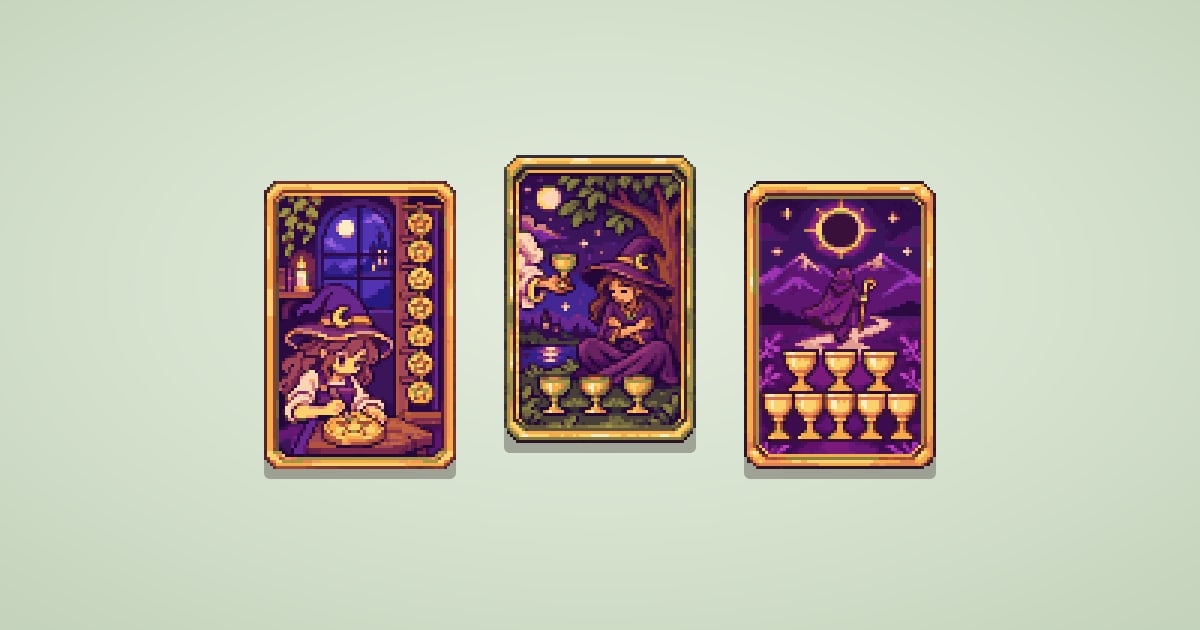
Read one at a time, these are three textbook meanings: diligence, apathy, leaving. Read as a line, they say something more specific.
The suits move from Pentacles to Cups to Cups: from the practical world to the emotional one, and they stay there. Whatever is happening is no longer about skill. The numbers run eight, four, eight. The craft was mastered (an eight is near the top of the suit), and the present has dropped back to a four, the number of standing still. There are no Major cards, which suggests an ordinary, workable situation rather than a crisis.
Now look at the pictures together. The craftsman is absorbed in his work; the young man under the tree is absorbed in nothing. The thing that made the work satisfying has gone flat. And the offered cup, the hand from the cloud, goes unnoticed. If the present continues, the third card shows where it leads: walking away from something that was built carefully, because the feeling has left it.
So the reading might go like this: You built real skill here, and the work stopped feeding you some time ago. Something new is being offered that you haven't looked at yet. If nothing changes, the cards point toward walking away, and it may be worth asking whether what you need is a new job or something new inside this one.
Notice how much of that came from the relationships between the cards rather than from the keywords. The Four of Cups on its own says "apathy". Placed between the Eight of Pentacles and the Eight of Cups, it says "the satisfaction of the craft has worn off, and you haven't noticed what's being offered."
When a card does not fit
Sometimes one card seems to belong to a different reading. Before you redraw, try three things.
First, read it more literally. A card about travel in a reading about a relationship might simply mean the distance between you. Second, read it as the voice of the part of you that you've been ignoring. Third, leave it open. Write it down and look again in a week. A card that made no sense at first often makes plenty a week later, which is one reason we suggest keeping a tarot journal.
What not to do is draw extra cards until the story becomes the one you wanted. One clarifying card is fine. Five is a different reading.
Other ways to use three cards
The past, present and future layout is only one way to use three positions. Once you are comfortable with it, the same method works with other questions.
| Positions | Good for |
|---|---|
| Situation, obstacle, advice | A problem you want to work on |
| What I know, what I don't see, what helps | Feeling stuck or confused |
| Your heart, the other, the bond | Reflecting on a relationship |
| Option A, option B, what to remember | A choice between two paths |
For a choice with more at stake, the four-card Crossroads spread gives each option its own card plus a guide.
Try it yourself
You can draw this spread with your own deck, or use the free three-card reading on this site, which draws from all 78 cards in your browser and places each meaning in its position. The spread page has a summary of the positions and suggested questions.
Whichever way you draw, say the reading out loud as one sentence before you look anything up. If you can tell the story in your own words, you have read the cards.
Keep reading
-
 Learn TarotHow to Read Tarot Cards for Beginners: A Practical GuideWhat the 78 cards are, how to ask a question the cards can work with, and how to read a card in context instead of memorizing a list.
-
 Love & Relationships15 Thoughtful Questions to Ask Tarot Cards About LoveQuestions that leave you clearer instead of more anxious, for when you're single, partnered, or picking up the pieces.
-
 Tarot SpreadsA Monthly Tarot Spread for the Start of a New MonthFive cards that turn the first days of a month into a quiet check-in, with a question waiting for you at the end.