
Can Tarot Predict the Future? A Thoughtful Look at What Tarot Can and Cannot Do
Where the idea came from, what readers actually believe, why readings can feel uncannily accurate, and how to use the cards without handing them your choices.
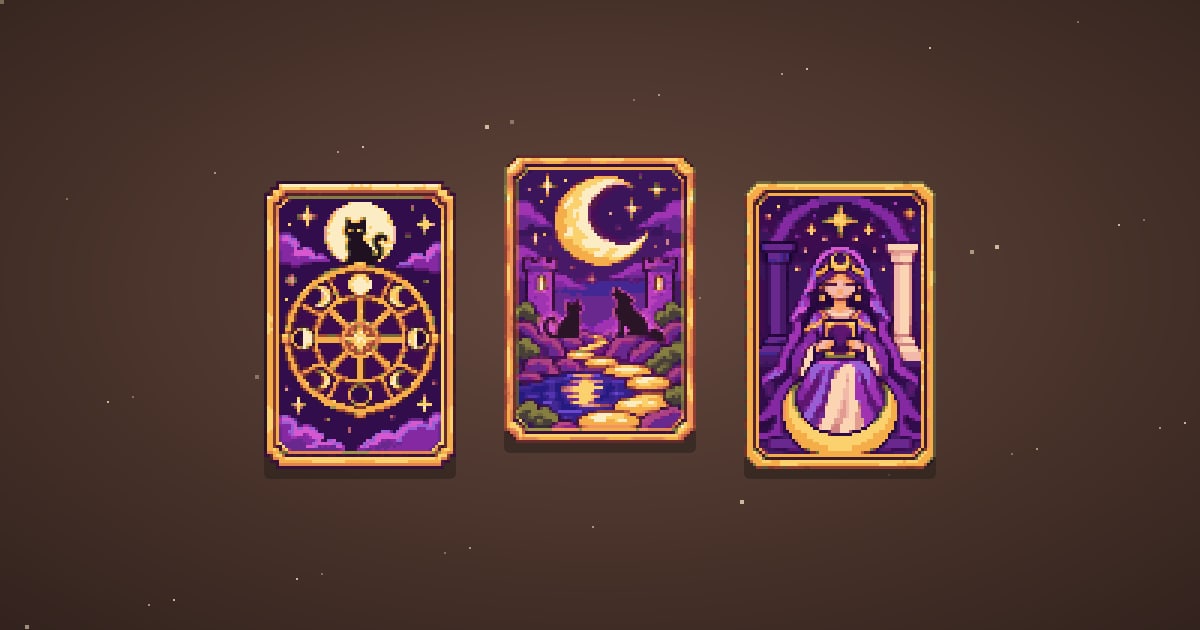
It is the question behind most first readings, even when nobody says it out loud: can the cards actually see what's coming? People give very different answers. Some readers believe tarot can glimpse the future, or at least the likely shape of it. Others see the cards as a tool for reflection with no special access to anything. Many sit somewhere in between, uncertain and comfortable with it.
We should say where we stand, since it shapes everything on this site. We don't believe tarot can reliably predict events, and we never present it that way. But that is not the end of the conversation, because "it can't predict the future" is not the same as "it does nothing". This article looks at both halves.
How the cards became fortune-telling cards
Tarot was not designed for divination. The earliest decks were made in fifteenth-century Italy for a card game, and the game is still played in parts of Europe today. There is no good evidence that the cards were widely used to tell fortunes for most of their first three centuries.
The change came in France in the late eighteenth century. In 1781 the scholar Antoine Court de Gébelin published the claim that the tarot's trumps were a surviving book of ancient Egyptian wisdom. There was no evidence for this (Egyptian hieroglyphs had not yet been deciphered), but the idea caught on. Within a few years, a Parisian cartomancer known as Etteilla was publishing tarot decks and guides designed for reading fortunes. Through the nineteenth century, occult writers in France and then England built ever more elaborate systems on that foundation, and in 1909 the Rider-Waite-Smith deck brought those ideas to a wide English-speaking audience.
This history doesn't settle the question either way. A practice can begin with a mistaken story and still become meaningful to people. But it does mean the "ancient Egyptian" aura that still surrounds tarot is an eighteenth-century invention.
What readers actually believe
It is easy to caricature tarot readers as people who think the cards are magic. Most aren't like that. Broadly, three views are common, and many readers hold more than one.
| View | The cards are... | A reading is... |
|---|---|---|
| Divinatory | A way to receive guidance from beyond the self: spirit, intuition, fate, or the divine | A glimpse of likely outcomes or hidden influences |
| Psychological | A set of archetypal images that prompt reflection | A way to see your own situation from a new angle |
| Practical | A structured random prompt | A conversation with yourself that a blank page can't start |
Even many readers who hold the first view describe what they see as tendencies rather than fixed fate: where things are heading if nothing changes. That is why so many spreads, including the past, present, future spread, describe the last card as a direction rather than a destiny.
We respect people who hold spiritual beliefs about tarot, and we don't think it is our place to talk anyone out of them. What we can say is that, to our knowledge, no well-controlled study has shown tarot predicting future events better than chance, and the belief that it can is a matter of faith rather than established fact.
Why readings can feel so accurate
If tarot can't see the future, why do readings so often feel startlingly personal? Psychology has some well-documented answers, and none of them require anyone to be dishonest.
The Forer effect. In a paper published in 1949, the psychologist Bertram Forer described giving his students what he said was a personalized personality profile. In fact every student received the same text, assembled largely from a newsstand astrology book. Asked to rate how well it described them on a scale from zero to five, the class gave it an average of 4.26. Statements like "you have a great deal of unused capacity" feel specific while fitting almost everyone. Card meanings are full of these: a card of "transition", "hidden worries" or "a choice to be made" will fit most lives most weeks.
Confirmation bias. We remember hits and forget misses. If a card about conflict appears and you argue with your sister three days later, the reading feels confirmed. The dozens of readings that pointed nowhere fade from memory. (A tarot journal is one of the best ways to see past this, because it keeps the misses too.)
Projection. The cards are pictures of people in situations, deliberately open to interpretation. When you look at The Moon, with its uncertain path and howling animals, what you see in it is shaped by what you're already worried about. The card works partly because it lets your own concerns surface.
None of this makes the experience fake. Feeling understood by a reading is real; it simply comes from you rather than from the cards knowing something.
What tarot can genuinely do
Set aside prediction, and tarot still does several useful things well.
It interrupts your usual thinking. When you are stuck, your mind tends to circle the same thoughts. A randomly drawn card is a new starting point you didn't choose, and it can pull you out of the loop.
It gives you language. Many people know they feel off without being able to say how. A card like the Eight of Swords, a bound and blindfolded figure surrounded by swords that don't actually block her way, can name a feeling you had no words for.
It slows you down. A reading takes ten quiet minutes. For some people, that is the only time in the week they think about a situation on purpose.
It brings out what you hope for. Notice your reaction when a card lands. Relief or disappointment is information about what you wanted, sometimes before you had admitted it.
| Tarot can | Tarot cannot |
|---|---|
| Help you reflect on a situation from a new angle | Tell you what will definitely happen |
| Give you words for a feeling | Reveal what another person is privately thinking |
| Prompt a decision you are ready to make | Make a decision for you |
| Offer a calm ritual for checking in with yourself | Replace medical, legal, financial or mental health advice |
Using tarot responsibly
A few principles keep tarot helpful rather than harmful, whatever you believe about it.
Keep your choices yours. A card can inform a decision; it shouldn't make one. If you notice that you won't act without a reading, or that you keep drawing until you get permission, it may be time to step back.
Don't use the cards for things that need an expert. Health symptoms, legal trouble, money decisions and mental health crises deserve real help. Our safety page lists places to start.
Be wary of anyone who claims certainty. A reader who says they can see exactly what will happen, that you are cursed, or that a problem can be removed for a fee is not offering reflection. Walk away.
Leave other people's minds alone. Readings about what someone else feels or intends are guesses dressed as answers. They can do real damage to how you treat that person.
Hold it lightly. Tarot is at its best when it is part of how you think, not a replacement for thinking.
So, can it?
Not in the sense of reliably showing what will happen. In our view, the future isn't written in a deck of cards, and you are not waiting to find out your fate. What tarot can do is help you see where you stand and where you seem to be heading, so that you can choose with your eyes a little more open. That is less dramatic than prophecy, and in most lives it is far more useful.
If you want to try a reading in that spirit, the free reading draws from the full deck in your browser. Our beginner's guide explains how to ask questions that lead somewhere.
Sources
- Bertram R. Forer, "The fallacy of personal validation: A classroom demonstration of gullibility," Journal of Abnormal and Social Psychology 44, no. 1 (1949): 118-123.
- Ronald Decker, Thierry Depaulis and Michael Dummett, A Wicked Pack of Cards: The Origins of the Occult Tarot (Duckworth, 1996), on Court de Gébelin, Etteilla and the beginnings of divinatory tarot.
- Michael Dummett, The Game of Tarot: From Ferrara to Salt Lake City (Duckworth, 1980), on tarot as a card game.
Keep reading
-
 Learn TarotHow to Read Tarot Cards for Beginners: A Practical GuideWhat the 78 cards are, how to ask a question the cards can work with, and how to read a card in context instead of memorizing a list.
-
 Self-DiscoveryHow to Start a Tarot Journal You'll Actually Want to KeepA five-line entry you can write in two minutes, how to spot the cards that keep coming back, and what to do when you read old pages.
-
 Learn TarotHow Does Tarot Work? An Honest AnswerTarot has no proven power to predict events, and it can still help you think. Here is how pictures, chance, structure and a pen do the work.