
How to Read Tarot Court Cards: Pages, Knights, Queens and Kings
Sixteen figures, one simple method: read the rank as a way of carrying the suit, then let the picture and your question show who the card is about.
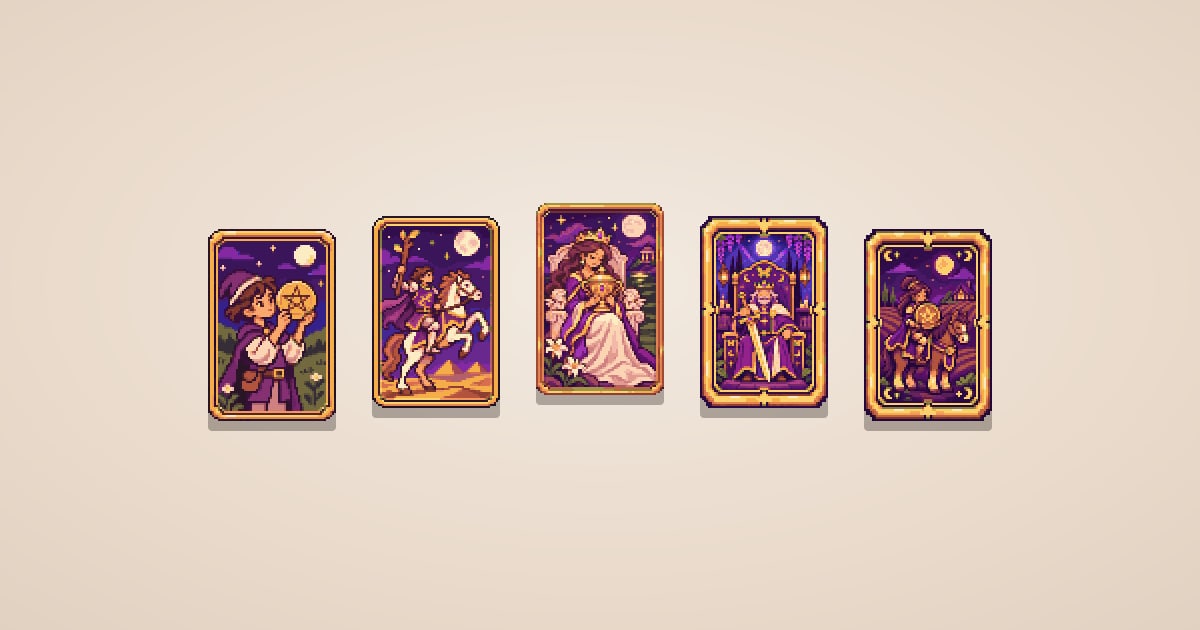
Court cards are the sixteen people of the tarot, four in every suit: Page, Knight, Queen and King. Beginners often find them the hardest cards to read, because a portrait tells you less than a scene. The short answer: take the rank as a way of carrying energy (Pages meet it, Knights move it, Queens hold it, Kings direct it). Take the suit as the kind of energy. Put the two together, then let the picture and your question decide whether the card describes you, something you could bring in, or someone in the situation.
Why court cards feel hard
Pamela Colman Smith drew most numbered cards as moments: someone sneaking from a camp with an armful of swords, three friends raising their cups. Court cards are closer to portraits, and they seem to ask who someone is rather than what is happening.
There is also an old habit behind the confusion. Earlier fortune-telling practice treated court cards as particular people, sorted by age, sex and coloring. You can still see it in A. E. Waite's own list of meanings for the Page of Wands:
Dark young man, faithful, a lover, an envoy, a postman.
Few readers work that way now. A card that means "a dark young man" sends you scanning your contacts for a match instead of thinking about your own life.
The four ranks as ways of carrying a suit
A helpful way to see the ranks is as four stages of growing into the same energy. Readers word this differently, but the broad shape is widely shared.
- Pages meet it. All four Pages are on foot, and the Pages of Cups and Pentacles gaze at what they hold as if seeing it for the first time. Waite says the Page of Pentacles "moves slowly, insensible of that which is about him." A Page is the student, the first try, the news just arrived.
- Knights move it. The Knights ride, so their energy is in motion. That is their gift and their risk, since motion can tip into rushing. Writing about the Knight of Wands, Waite gives a line that works for all four: "The motion of the horse is a key to the character of its rider." Compare the galloping Knight of Swords with the Knight of Pentacles, whose heavy horse stands still.
- Queens hold it. The Queens sit on thrones. A Queen has lived with her suit long enough to know it from the inside, and carries it with care and experience, often turned inward.
- Kings direct it. The Kings are enthroned too, but their energy faces outward: responsibility, decisions, the people who rely on them. A King knows the suit well enough to be trusted with it. When a King struggles, it is usually with control or rigidity.
No rank is better than another. You can be a Page in one part of life and a King in another, and a Page again whenever you start something new.
The grid: suit times rank
Once you know the ranks, add the suit. Each suit has its element: Fire for Wands, Water for Cups, Air for Swords, Earth for Pentacles. (The article on the four elements in tarot explains that pairing.) Each court card becomes a short sentence: this rank, carrying this element.
| Suit | Page | Knight | Queen | King |
|---|---|---|---|---|
| Wands (Fire) | First spark | Bold chase | Warm confidence | Leading vision |
| Cups (Water) | Tender curiosity | Following the heart | Deep care | Calm feeling |
| Swords (Air) | Sharp questions | Rushing words | Honest clarity | Fair judgment |
| Pentacles (Earth) | Patient study | Steady effort | Practical nurture | Secure stewardship |
Treat the grid as a starting point, never an answer key. The picture always adds something. The King of Cups, for instance, sits on a throne set out on open water, with a ship on one side and a leaping dolphin on the other: feeling that stays level while everything around it moves. Every card has its own page in the tarot card meanings.
Three ways to read a court card in a spread
When a court card turns up, you have three good options. Your question and the position usually suggest which to try first.
1. As a side of yourself
Ask: where am I already being this? A Knight of Wands in a reading about work might reflect how fast you have been moving lately, for better and for worse. This is often the most useful reading, because it is the one you can act on.
2. As a quality to bring in
Ask: what would change if I carried things the way this figure does? If you feel stuck and draw the Page of Swords, the card might invite curiosity: asking questions, checking facts, being willing not to know yet. This reading suits positions like "advice" or "what would help."
3. As someone in the situation
Sometimes a court card brings a real person to mind: a patient coworker, a friend who rushes in. That is fine, and it can help you think about the part they play. But hold one rule firmly. A card never tells you what another person thinks, feels or intends. It can echo a way of behaving you have actually seen. It cannot see inside anyone. If you need to know how someone feels, the only reliable source is that person: what they say, and what they do over time.
Gender and age on the cards are not literal
The Rider-Waite-Smith courts were drawn with the conventions of their time: Pages as youths, Knights as young men in armor, Queens as women, Kings as older rulers. These are pictures of roles, not limits on who a card can be about. Anyone, of any age or gender, can be the Queen of Swords on the day they tell a hard truth kindly, or the Page of Cups the first time they let themselves feel something new.
The order of the ranks is not a ladder of worth either. A King is not a better person than a Page, and a Page is not a child. Someone retired who has just picked up a paintbrush is very much a Page of Wands.
History supports this flexibility. In early European playing cards, according to the Wikipedia overview of the Minor Arcana, the court was a king, a knight and a page, and many early tarot decks added female figures alongside them. Decks have named and drawn their courts in many ways since.
A brief note on the Golden Dawn names
Waite and Smith were members of a magical society, the Hermetic Order of the Golden Dawn, which used the titles Princess, Prince, Queen and King. Aleister Crowley's Thoth deck kept those changed names but put Knight where King had been, giving Princess, Prince, Queen and Knight, as the Wikipedia article on the Thoth Tarot sets out. Teachers still disagree about exactly how those titles match Page, Knight, Queen and King, so with those decks, follow the deck's own book.
An exercise: you on a good day, you on a hard day
Where to go next
Keep your two cards somewhere you will find them again: a notebook, our tarot journal templates, or, if you use the Emberlune app, the journal where Luna keeps your readings.
The course lesson on court cards has more examples, and the Learn Tarot course sets the courts beside the Major Arcana and reversals. For reversed courts, see reading reversed tarot cards. If one court card makes you bristle, the shadow work article has a gentle practice for that.
Sixteen figures can feel like a crowd at first. Give them time, and most of them start to look like people you already know, including several versions of yourself.
Keep reading
-
 Learn TarotThe Four Elements in Tarot: Fire, Water, Air and EarthHow the four suits carry the four elements, what each one brings to a reading, and what to do when a spread leans hard one way or leaves something out.
-
 Self-DiscoveryShadow Work With Tarot: A Gentle, Practical ApproachFour careful ways to use the cards to look at the parts of yourself you'd rather not, and where the limits are.
-
 Learn TarotHow Does Tarot Work? An Honest AnswerTarot has no proven power to predict events, and it can still help you think. Here is how pictures, chance, structure and a pen do the work.