
The Four Elements in Tarot: Fire, Water, Air and Earth
How the four suits carry the four elements, what each one brings to a reading, and what to do when a spread leans hard one way or leaves something out.
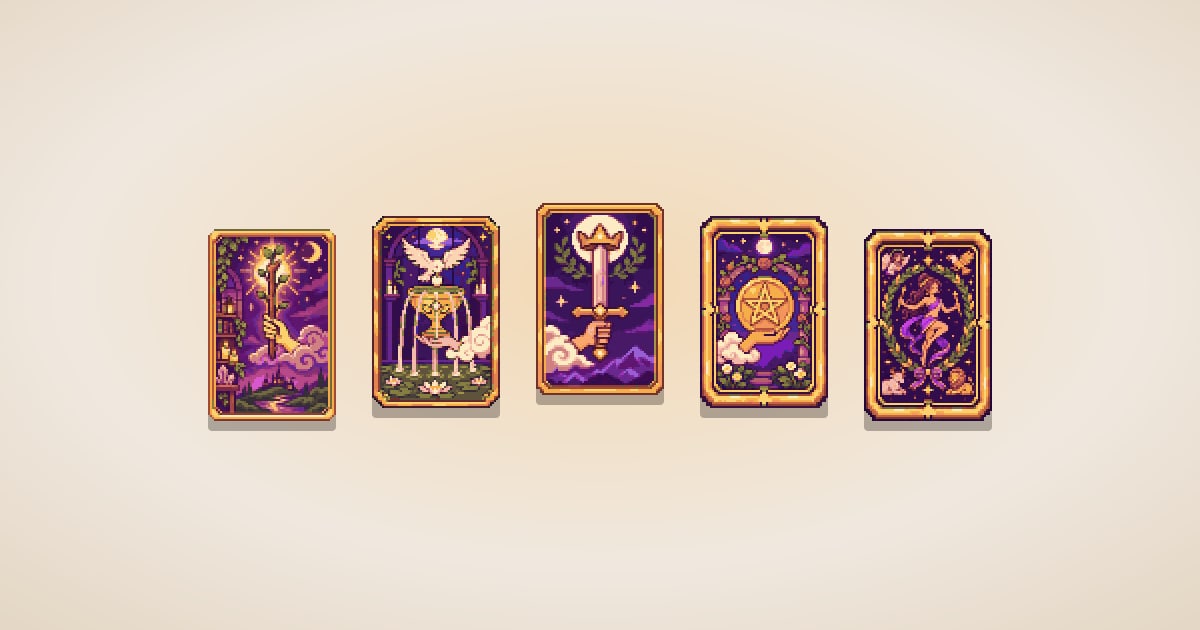
In the Rider-Waite-Smith tradition, each of the four tarot suits belongs to one of the classical elements. Wands are Fire. Cups are Water. Swords are Air. Pentacles are Earth. That one pairing gives you a quick first read of any Minor Arcana card before you know its detailed meaning: you already know which kind of energy it is talking about.
Below: where the pairing comes from, how to see each element in the pictures, and gentle ways to use it: balance in a spread, an optional technique called elemental dignities, and the zodiac link.
The pairing at a glance
| Suit | Element | What it tends to bring into view | When there is too much of it |
|---|---|---|---|
| Wands | Fire | Drive, desire, creativity, courage, the urge to begin | Burning out, rushing, impatience |
| Cups | Water | Feelings, closeness, longing, imagination, care | Being flooded, drifting, losing your edges |
| Swords | Air | Thought, words, decisions, truth, conflict | Overthinking, sharpness, worry that circles |
| Pentacles | Earth | Body, money, work, home, time, routine | Feeling stuck, heaviness, holding on too tight |
The right-hand column is not a warning. Every element is welcome in a life, and each one can tip over when it has nothing to balance it, the way a fire with no hearth spreads or a field with no rain cracks.
Where the pairing comes from
The system used with the Rider-Waite-Smith deck was taught by the Hermetic Order of the Golden Dawn, an occult society founded in London in 1888. Both A. E. Waite and the artist Pamela Colman Smith were members, and the deck they made was published in 1909. The Golden Dawn tied the tarot to astrology, the elements and the Hebrew letters, and the suit and element pairing above is the part most modern readers still use.
It is not the only system. Some readers and decks swap Fire and Air, giving Wands to Air and Swords to Fire, on the reasoning that a wand is a wooden staff and a sword is forged in flame. Neither choice is more correct. What matters is that you pick one and keep it, so your readings stay consistent. Our free course covers the basics in the lesson on suits and elements; here we go a step further.
See the elements in the four Aces
The Aces are the clearest place to watch the elements at work, because each one shows a single suit symbol offered by a hand from a cloud, set against a landscape. Smith gave every Ace a different world around that hand.


The Ace of Wands: Fire. Waite describes only "a stout wand or club", but Smith drew it alive, with new leaves breaking from the wood. Fire in tarot is less about flames than about what feeds them: living, growing energy that wants to be used. In a reading, Wands tend to ask what you want, what excites you, and where your effort is going.
The Ace of Cups: Water. This is the most watery picture in the deck: a pond with lilies, streams spilling over the rim of the cup, drops falling all around. Waite's text mentions four streams; count them in Smith's drawing and most people find five. Water moves, fills whatever holds it and reflects what is near it. Cups tend to ask what you feel, who you feel close to, and what you need.
The Ace of Swords: Air. Most of this card is open sky. The blade points straight up into it, crowned, with bare mountains far below. Air is the element you cannot hold but cannot live without, and Swords cover the invisible things that shape a situation: thoughts, words, beliefs, the story you are telling yourself. Some Swords hurt to look at, and some bring the relief of seeing clearly.
The Ace of Pentacles: Earth. Here the ground matters as much as the coin. Below the hand is a tended garden with a path running through an archway in a hedge. Earth is slow, solid and real. Pentacles tend to ask about your body, your time, your money and your daily routines: the conditions that make anything else possible.
Reading the elemental balance of a spread
Once you know the elements, you can step back from a spread and simply count. Court cards carry the element of their suit. (Some systems also give each court rank a second element of its own, and teachers assign those differently, so it is fine to leave that layer aside.) The Major Arcana sit outside the four suits, though the Golden Dawn did give three of them an element each: The Fool to Air, The Hanged Man to Water and Judgement to Fire. The Major vs Minor Arcana article explains that split.
A few gentle ways to read what you count:
- One element leads. The reading may be most interested in that part of the situation. Three Swords in a question about a friendship might point you toward the conversation you keep rehearsing in your head, more than toward the feelings underneath it.
- Two elements meet. Look at how they relate. Fire and Air feed each other, like wind on a flame. Water and Earth hold each other, like a riverbank. Fire and Water, or Air and Earth, can pull in different directions, which is often just a description of an honest tension: wanting to act and needing to feel, or thinking it through and having to live with the practical facts.
- An element is missing. Treat it as a question rather than a verdict. A three-card spread only shows three cards. "Where is the Earth in this?" can be a useful prompt, and the honest answer may be "it is already taken care of."
Elemental dignities, briefly
Elemental dignities is an older technique from the Golden Dawn tradition, and it is entirely optional. Instead of reading each card alone, you read it with the cards on either side. Cards of the same element strengthen each other. Opposing elements, Fire with Water and Air with Earth, weaken each other, and a card between two opposites is said to be "ill-dignified": its meaning comes through more quietly, or with more difficulty. The remaining pairings are treated as friendly, though teachers differ on how strongly. Some readers who use dignities do not use reversed cards at all, letting the neighbors do that work instead. You will find a short definition in our tarot glossary.
"Weakened" is not a bad omen. It describes how loud a card is in that spot, nothing more. If dignities feel like one more rule to remember, leave them for later. Card meanings, the picture and your own question carry a reading perfectly well, and combining cards does not depend on this method.
The elements and the zodiac
The elements are also the bridge between tarot and astrology. The twelve signs fall into four groups of three: Aries, Leo and Sagittarius are Fire; Cancer, Scorpio and Pisces are Water; Gemini, Libra and Aquarius are Air; Taurus, Virgo and Capricorn are Earth. In the Golden Dawn system, the numbered cards from Two to Ten are shared out among the signs of their own element, three cards to each sign. That is why the Two, Three and Four of Wands belong to Aries, the first Fire sign. Look up your own sign's cards in zodiac tarot cards.
The idea also shows up in the pictures of the Majors. In the four corners of The World, Smith drew a human face, an eagle, a bull and a lion. Many readers link them to the four fixed signs, Aquarius, Scorpio, Taurus and Leo, which makes one figure for each element, gathered around the dancer at the end of the deck.
Keep it light
The elements are a lens, not a rulebook, and you need no astrology to use them. They help you ask "which part of my life is this card about?" and "what might this need more of?" To spot patterns over time, tally the elements across a few weeks of journaled readings (Luna, in the Emberlune app, can keep that journal for you).
To keep learning, the numbers are the natural next layer: what tarot numbers mean pairs well with everything here. And when you want to practice, a free tarot reading is a good place to start counting Fire, Water, Air and Earth.
Keep reading
-
 Learn TarotHow to Read Tarot Card Combinations: A Simple Method With 12 ExamplesGive each card a simple meaning, notice how they meet, and let your question turn two pictures into one useful thought.
-
 Learn TarotTarot Numerology: What the Numbers Mean, Ace to TenForty numbered cards become ten patterns once you see them side by side, as long as the pattern stays a starting point and never a verdict.
-
 Learn TarotHow Does Tarot Work? An Honest AnswerTarot has no proven power to predict events, and it can still help you think. Here is how pictures, chance, structure and a pen do the work.