
How to Choose Your First Tarot Deck: What Actually Matters
There is no correct first deck, only one you will want to pick up again. Here is what to look for, and how to practice for free before buying anything.
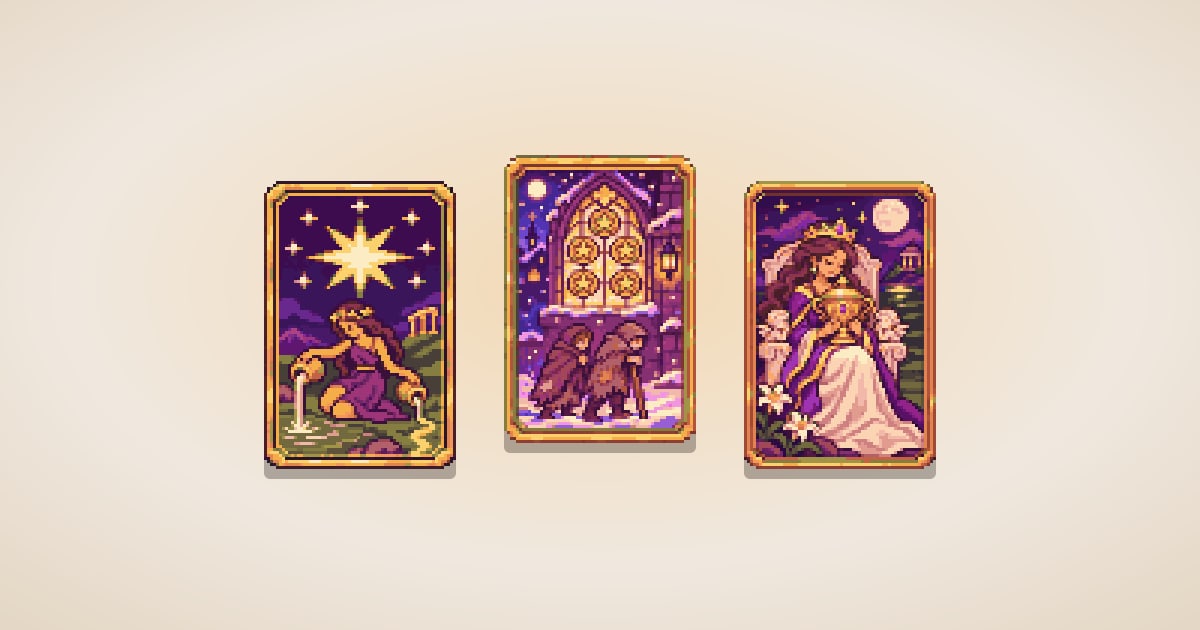
If you are looking for your first tarot deck, choose a 78-card deck that follows the Rider-Waite-Smith pictures, with a full scene drawn on every numbered card, in a size your hands can shuffle comfortably, with art you enjoy looking at. That combination makes the first months easier, because most beginner guides in English, and our own card pages, assume those pictures. Past that point, the best beginner deck is simply the one you will actually want to pick up.
This guide names no brands, artists or shops. Decks go in and out of print, and taste is personal, so instead it covers what to check in any deck you come across.
Start with the picture tradition
Tarot decks share one structure of 78 cards, which our lesson on how the deck is built lays out. What changes from deck to deck is how the cards are drawn, and for a beginner the biggest difference shows up in the numbered cards of the four suits.
Rider-Waite-Smith style. The deck first published in 1909 gave every numbered card, Ace through Ten in each suit, a scene of its own. On the Five of Pentacles, two people struggle through snow beneath a lit church window. On the Three of Cups, three figures lift their cups together. You can start reading these pictures before you know a single keyword. Many modern decks redraw the same scenes in a new style while keeping the composition, so what you learn from one usually carries over to many others. Emberlune's own card art is drawn in this tradition, which is why our card meaning pages will match a deck like this closely.
Marseille style. This older tradition, associated with French card makers, illustrates the Major Arcana but usually shows the numbered cards as pip cards: an arrangement of cups, coins, swords or batons, often framed with flowers and stems, with no people and no scene. Readers who love these decks work from number, suit and arrangement, and some find that spareness restful. It is a rich way to read, though it asks for more memorizing at the start. If you lean this way, our guide to what tarot numbers mean is a useful companion.
Plenty of decks invent imagery entirely their own. Some are lovely. For a first deck, check whether its guidebook explains each card well enough to stand without outside help, because general books and websites may not fit its pictures.
Make sure it really is tarot
Check that the box or listing says 78 cards, with four suits. Some card decks sold alongside tarot are oracle decks, which have their own number of cards and their own system. They can be wonderful, but they work differently, as our comparison of tarot and oracle cards explains. Some tarot decks also rename a suit, calling Pentacles "Coins" or Wands "Rods", or add a spare card or two. None of that is a problem as long as the guidebook says what corresponds to what.
How the cards feel in your hands
Tarot cards are bigger than ordinary playing cards, and that surprises many people the first time they try to shuffle. If your hands are small, stiff or sore, look for a smaller edition, or plan to mix the cards by spreading them on a table. Our guide to shuffling tarot cards has gentler methods.
A few other physical details are worth a glance:
- Card stock. Thin, flexible cards shuffle easily but crease sooner. Thick, stiff cards last longer and can be tiring to shuffle.
- Finish. A glossy surface slides well and can catch glare under a lamp. A matte surface is calmer to look at and grips a little more.
- Edges. Gilded or painted edges look beautiful, and some readers find the cards cling together when new.
- Borders and titles. Printed card names help while you are learning. Borderless cards give more room to the art.
- The back design. If you plan to read reversed cards, a back that looks identical either way up keeps you from spotting reversals before you turn them over.
Art you will want to look at
A reading usually begins with noticing something in the picture: a hand, a color, a face turned away. If a deck's art bores you, you will reach for it less often, and if it unsettles you, every reading starts on edge. So the most personal test is also the most important one. Do you like spending time with these images?
Can you tell what the people are doing and feeling? Then look at the hardest cards, such as the Ten of Swords or The Tower. Some decks draw them with great force, others more softly. If you are coming to tarot during a difficult season, gentler art may simply be kinder. Our article on frightening tarot cards talks about why certain pictures land so heavily.
Do the people in the cards include you?
The 1909 pictures show mostly pale-skinned figures and couples made of a man and a woman. Many newer decks draw a wider range of skin tones, ages, body shapes, genders and relationships. Nothing requires you to choose one of them. Still, for many readers it changes a great deal to see someone who looks like them as the Queen of Cups or among the Lovers. If you have ever felt like a guest in the pictures, it is fair to make this part of your choice.
A guidebook you can read
Most decks include a small booklet, sometimes called the "little white book", and some come with a full-length book. When you can see a sample, ask:
- Does it describe what is happening in each picture, or only list keywords?
- Does it explain reversals, if the deck uses them?
- Is the type comfortable to read?
- Does it avoid frightening predictions and absolute statements?
A thin booklet is not a reason to reject a deck you love. Our tarot glossary, the free learn tarot course and the card pages can fill the gaps, and lessons such as the Major Arcana and reading reversals assume no particular book.
Does a first deck have to be a gift?
You may have heard that your first tarot deck should be given to you rather than bought. It is a piece of folklore, and like a lot of folklore it carries a kind idea: that a deck can arrive surrounded by care. It is not a rule, though, and waiting for someone to guess that you want a tarot deck could take a very long time. Buying your own is completely fine. If you like the feeling of a gift, you can make the purchase one to yourself: choose slowly, and mark the date somewhere you will see it later. We look at this and similar stories in can you read tarot for yourself.
The same goes for secondhand decks. Some people avoid them, others enjoy a deck that has already been handled. If a used deck feels like it still belongs to someone else, a simple ritual such as those in our guide to cleansing tarot cards can help you make it yours.
Practice before you buy anything
You do not need a physical deck to begin learning. A free tarot reading, the tarot card of the day and the first week of tarot all use full illustrated cards in the Rider-Waite-Smith tradition. A week or two with them tells you things no product listing can: whether scenes help you, whether you want to read reversals, and whether a daily card suits your routine.
When the deck arrives
Look at every card once, face up, and sort the deck into the Majors and the four suits. If you would like a playful way to begin, the deck interview spread is built for exactly this moment. Keeping a short record helps too, whether in a notebook or one of our tarot journal templates. If you also read in the Emberlune app, Luna keeps those readings in a private journal.
Your first deck is a starting point, not a lifelong promise. If you outgrow it, what you learned from its pictures goes with you to the next one.
Keep reading
-
 Learn TarotTarot vs Oracle Cards: What Is the Difference?Two kinds of illustrated cards that sit side by side on a shelf, work quite differently in the hand, and can both support honest reflection.
-
 Tarot SpreadsThe Tarot Deck Interview Spread: Getting to Know a New DeckSix playful questions can help you study a new deck and choose how you want to practice with it.
-
 Learn TarotHow Does Tarot Work? An Honest AnswerTarot has no proven power to predict events, and it can still help you think. Here is how pictures, chance, structure and a pen do the work.