
Tarot for Anxiety: When It Helps, and When It Feeds the Worry
The cards can slow a racing mind or speed it up. How to tell which is happening, and a small spread for the days when worry is loud.
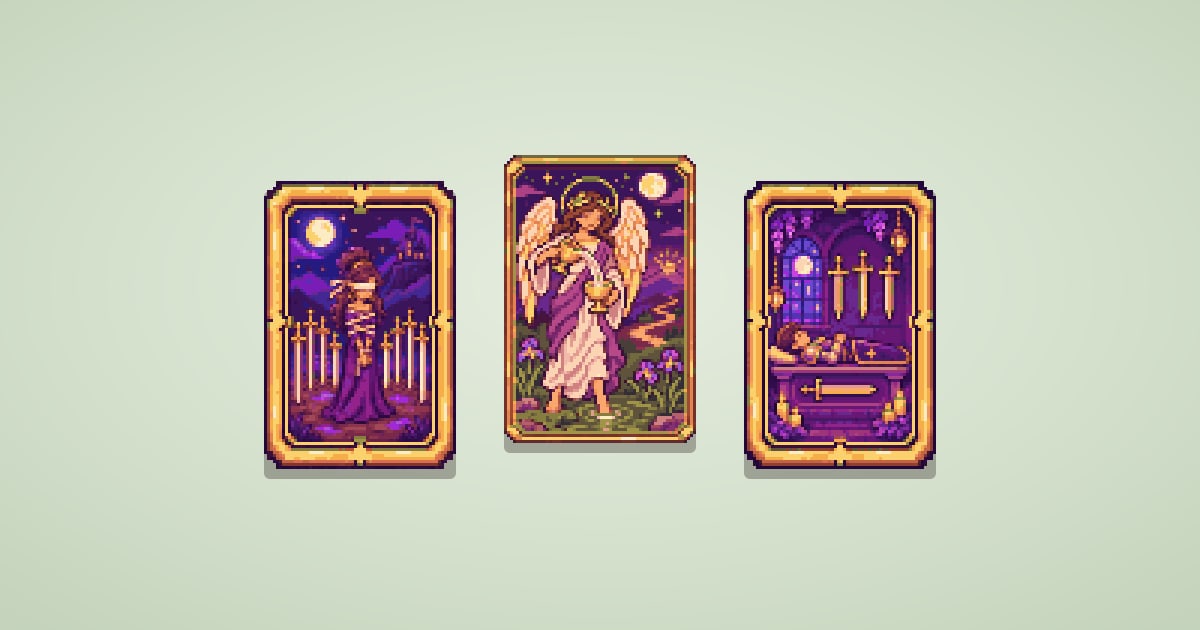
If you are searching for tarot for anxiety, you probably want to know one thing first: can it actually help? The honest answer is yes, sometimes, in a limited way, and it can also make things worse.
Tarot is not a treatment for anxiety, and it cannot tell you whether the thing you are afraid of will happen. What it can offer is a slow, quiet ritual: a few minutes where you sit still, look at a picture, and put a vague dread into words. For some people, on some days, that is genuinely calming. The same deck, used to check and recheck a fear, can keep a worry spinning for hours.
This guide is about telling those two apart. It ends with a gentle three-card spread built for grounding, not for answers, and a short breathing pause you can use before and after.
Why the cards can help
Anxiety often arrives as a fog. You feel tense and uneasy, but the cause is blurry, or there seem to be twenty causes at once. Naming a feeling, even roughly, can make it easier to hold.
A tarot card gives you something outside your head to look at. Instead of circling the same thought, you describe a picture: a figure standing in water, a cup being poured. That slow, concrete work brings your attention to your eyes and hands for a moment, away from the next imagined disaster.
The ritual itself can help too. Clearing a small space, shuffling at your own pace, laying out three cards: these are small, predictable actions with a beginning and an end. When everything feels uncertain, a practice with edges can be a relief.
Why the cards can feed worry
The trouble starts when the deck becomes a way to get reassurance. Reassurance seeking means looking for someone or something to tell you that the feared thing will not happen. It feels good for a moment, and then the doubt comes back, often stronger, and you need to check again.
Tarot fits into that loop very easily. A few common patterns:
- Redrawing. You pull a card you do not like, so you shuffle and draw again, looking for a kinder one.
- Asking the same question over and over. "Will the test results be fine?" in the morning, at lunch, and again before bed.
- Reading late at night. Tired minds read darker meanings into ordinary pictures. We wrote about worry in the small hours separately.
- Asking about other people's thoughts. "Is my friend angry with me?" No card can answer that, and the uncertainty tends to grow.
None of this means you have done something wrong. It means the cards are being asked for a certainty they do not have.
Helping or feeding? A quick check
After a reading, take a moment to notice what happened in your body and your thoughts. These are rough signs, not rules.
A reading is probably helping when:
- You feel a little slower or steadier than before you started.
- You can name what you are worried about more clearly.
- You found one small thing you can do, or decided that nothing needs doing today.
- You are able to close the deck and move on to something else.
A reading is probably feeding the worry when:
- You want to draw again straight away.
- Your heart is racing more than when you began.
- The question you asked was "will it be okay?" and you still do not feel okay.
- You have read about the same fear more than once today.
If the second list sounds familiar, close the deck. That is a complete reading. You can come back another day, or not at all, and nothing is lost.
A picture of anxious thinking
One card shows the anxious mind with unusual tenderness: the Eight of Swords. On the 1909 card, a figure stands bound and blindfolded, with eight swords planted in the wet ground around them and a castle far off on a hill. Waite, who wrote the deck's companion book, described it this way:
A woman, bound and hoodwinked, with the swords of the card about her. Yet it is rather a card of temporary durance than of irretrievable bondage.
Temporary durance: a confinement that does not last. Many readers also notice that the figure's feet are not tied, and that the swords do not quite form a closed circle. Readers differ on how much to make of these details, but they offer a gentle question. Which of the swords around you are real walls, and which only feel like walls because you cannot see past the blindfold right now?
A three-card grounding spread
This spread asks nothing about the future. Every position points toward the present: what you are holding, what you can touch, and what helps your body settle. Our tarot spreads page has more layouts; this one is for anxious days.
Lay three cards in a row, left to right.
- What am I carrying? The weight you brought to the table today. Look at the picture and ask which part of it resembles how you feel.
- What is within my reach today? Something small, present and possible. Look for a hand, a tool, a path, an open door in the image.
- What helps my body feel safe? Rest, movement, warmth, company, food, quiet. Let the picture suggest one ordinary comfort.
A few suggestions as you read:
- Read the picture, not the forecast. Describe what is actually drawn before you reach for a meaning.
- A hard card in the first position is not bad news. It is often simply accurate. Heavy days look heavy.
- Reversed cards can mean the energy is turned inward or slowed down. If reversals make you anxious, leave all the cards upright. Our lesson on reversals explains both approaches.
- Stop after three cards. No clarifiers, no extra draws. If one card stays confusing, write "I don't know yet" and leave it.
If you would like to keep your spreads, a page from our tarot journal templates or a simple notebook works well. Our guide to starting a tarot journal has more ideas.
A breathing pause
Use this before you shuffle, and again after you put the cards away. It is not a treatment, only a way to slow down.
When to set the cards aside
Tarot is a reflection practice, not care for anxiety. If worry is overwhelming, keeps you from sleeping, eating or working, comes with panic you cannot ride out, or has lasted for weeks or months, please talk to a doctor or a person you trust. You do not have to have the right words first. "I have been really anxious and I don't know what to do" is enough to begin.
If you feel unsafe right now, our safety page lists free, confidential crisis lines in many countries. And if today is simply heavy, a card for a hard day offers one gentle card and nothing to decide.
Keeping the practice gentle
Used kindly, the cards can be one quiet habit among others: a walk, a call to a friend, something warm to drink. Keep readings short, keep them in daylight when you can, and let the deck sit closed whenever it starts to feel like a test.
If you like having your readings in one place, the Emberlune app keeps them in a private journal with Luna, so you can look back at what you were carrying a month ago and notice how much of it has already passed. Many of the swords that seemed fixed in place were only there for a while.
If you are new to the cards, the Major Arcana lesson is a calm place to start, and our piece on reading tarot for yourself covers the basics of a solo practice.
Keep reading
-
 ReflectionsThe Nine of Swords and the 3 a.m. MindOn the card of sleepless nights, the swords that never touch her, and what to do with the thoughts that come in the dark.
-
 Self-DiscoveryHow to Start a Tarot Journal You'll Actually Want to KeepA five-line entry you can write in two minutes, how to spot the cards that keep coming back, and what to do when you read old pages.
-
 Self-DiscoveryA Morning Tarot Ritual: A Gentle Five-Minute Daily PracticeOne card with your tea or coffee, three plain questions and a line in a notebook, kept small enough that a missed morning never feels like failing.