
Tarot Cards That Are Easy to Mix Up, and How to Tell Them Apart
A picture-led study guide to seven tarot pairs whose shared themes can make their differences hard to remember.
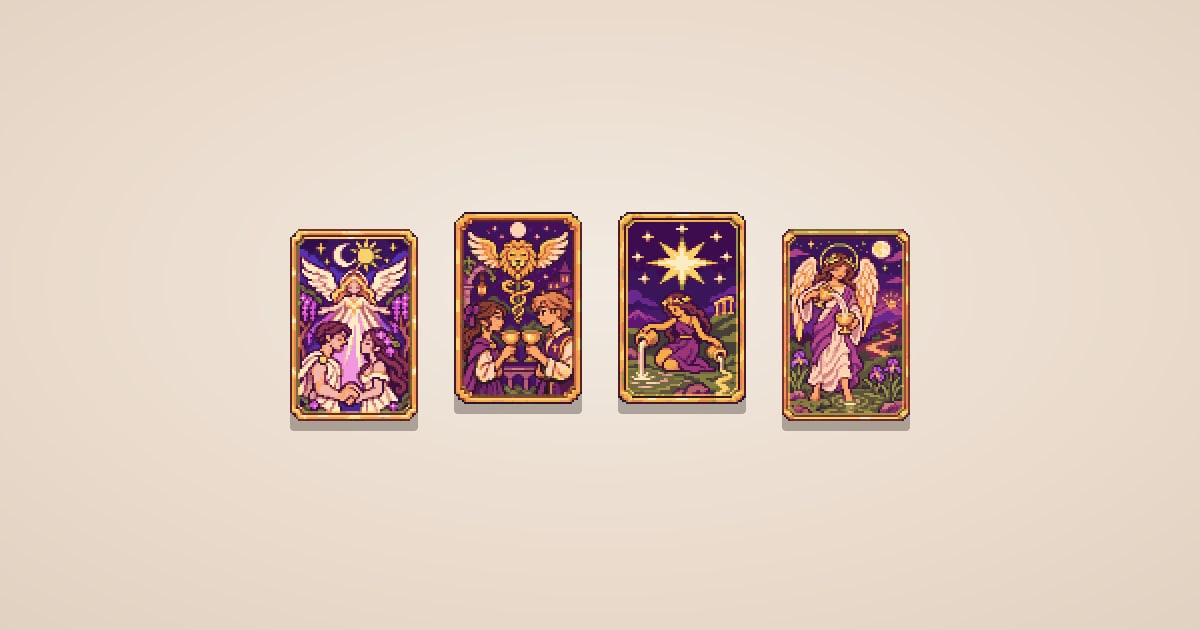
You remember that a card means connection, then meet another card that seems to mean exactly the same thing. If that has happened to you, you are in good company. Almost everyone who learns tarot has a few cards that keep swapping places in their head.
Here is a gentle trick: study the look-alikes side by side. Give each card its own action, then find one thing in the picture that helps you remember it. The pictures here are the 1909 Rider-Waite-Smith cards, as A. E. Waite describes them in The Pictorial Key to the Tarot. The everyday examples are ours, offered as ways to study, not as rules.
Keep your deck nearby if you have one. You can work through these pairs alongside our free tarot course, returning to whichever pair still feels slippery.
Seven pairs at a glance
| Pair | Shared theme | The difference | Look for |
|---|---|---|---|
| The Lovers / Two of Cups | Love and connection | Values and commitment / mutual exchange | Winged figure above two people / cups beneath a winged lion's head |
| The Star / Temperance | Sustaining life | Hope and replenishment / moderation and integration | Water poured onto land and water / liquid passing between chalices |
| Death / The Tower | Major change | An ending and passage / a disruptive collapse | Horseman with a banner / a ruined building with two sufferers |
| The High Priestess / The Moon | Mystery | Quiet receptivity / uncertainty and imagination | Scroll marked Tora / path between towers |
| The Emperor / King of Pentacles | Stability and competence | Authority and structure / practical stewardship | Rams' heads / bull's heads on the throne |
| Four of Swords / The Hermit | Withdrawal | Restful retreat / reflection and guidance | Praying knight's effigy / star inside a lantern |
| Eight of Cups / Six of Swords | Departure | Leaving a former concern / making a passage | Abandoned cups / ferryman carrying passengers |
The question and spread position help you choose which aspect deserves attention. A card can carry several meanings while still having a recognizable center.
The Lovers and Two of Cups
Both cards make room for affection, attraction, and meaningful connection. Waite gives love to each, so their overlap has a sound basis.
For study, let The Lovers widen the question to the values that shape a bond. What are you committing to, and how does that commitment fit the person you want to be? The Two of Cups brings attention to reciprocity between participants. How are care, attention, or agreement being exchanged?
Say you are wondering about a friendship. The Lovers might ask what you both believe in. The Two of Cups might ask how each of you shows up for the other.
Picture cue. Waite describes two unveiled human figures beneath a large winged figure in The Lovers. In the Two of Cups, two people pledge themselves to each other with cups, beneath a caduceus and winged lion's head. Remember who is above them and what they hold.
Memory hook. The Lovers asks what you commit to, and the Two of Cups asks how you meet each other.
The Star and Temperance
These cards share water imagery and a sense of sustaining life. What each figure does with the water is the easiest way to tell them apart.
The Star supports a study reading of hope, openness, and replenishment. Waite includes hope among its divinatory possibilities, alongside harsher alternatives. Temperance emphasizes moderation, management, and the integration of different needs. Its balance involves ongoing adjustment.
After a demanding week, The Star might invite you to name what restores your faith. Temperance might invite you to adjust the proportions of work, company, and rest in your schedule. Both prompts can support recovery through different kinds of attention.
Picture cue. The Star's unclothed figure pours from two vessels onto land and water, with one knee on land. Temperance shows a winged angel transferring liquid between chalices. Follow the destination of the liquid before trying to remember a keyword.
Memory hook. The Star replenishes, and Temperance regulates the mixture.
Death and The Tower
Both can give a reading the theme of substantial change. Waite discusses transformation and passage in Death, and ruin and catastrophe in The Tower.
Use Death to examine an ending, the release it requires, and the transition that accompanies it. Use The Tower to examine disruption to a structure or assumption. Waite's discussion of a house of falsehood gives the Tower's collapse an intellectual dimension as well.
Think of a job. Death could frame the closure of a role you have outgrown. The Tower could frame the discovery that your understanding of that workplace needs rebuilding. The difference is the kind of change: one is a goodbye, the other is a shake-up.
Picture cue. Waite describes Death's slowly moving horseman carrying a black banner with a rose. His Tower discussion identifies a ruined building and two human sufferers. Picture a passage in motion beside a structure coming apart.
Memory hook. Death closes a chapter, and The Tower breaks a framework.
The High Priestess and The Moon
Both belong near questions about mystery and incomplete understanding.
The High Priestess invites quiet attention to what you have yet to articulate. Waite associates her with silence, wisdom, and secrets. The Moon invites examination of imagination, fear, and uncertain impressions. Waite explicitly connects its picture with the imagination and the mind's fears.
With the High Priestess, try giving an impression time and language. With The Moon, write down the facts you know and the interpretations you have added. Both make room for not knowing yet, and both give you something small and kind to do with it.
Picture cue. The High Priestess holds a scroll bearing the word Tora and has a crescent at her feet. The Moon offers a path between towers, with a dog and wolf below. Let the scroll suggest patient attention and the path suggest questions about visibility.
Memory hook. The High Priestess listens quietly, and The Moon asks how clearly you can see.
The Emperor and King of Pentacles
Both can suggest competence, steadiness, and responsibility.
The Emperor concerns authority, structure, and the exercise of will. Think about who sets boundaries, establishes expectations, or makes decisions. The King of Pentacles concerns practical capability and the stewardship of resources. Waite's meanings include business aptitude and success through applied intelligence.
For a household project, The Emperor might prompt agreement about responsibilities. The King of Pentacles might prompt a realistic budget and a workable maintenance plan. For help placing a Major card alongside a court card, revisit the course lesson on the Major Arcana.
Picture cue. Look at the thrones. Waite names rams' heads on The Emperor's throne arms and a recurring bull's head on the King of Pentacles' throne. The animals provide a compact identification aid.
Memory hook. The Emperor establishes the structure, and the King of Pentacles manages its resources.
Four of Swords and The Hermit
Both can draw attention to stepping away from activity. Waite even includes a hermit's repose among the Four of Swords' meanings.
The Four of Swords supports retreat and a pause in demands. In a study reading, ask what needs quiet or recovery. The Hermit supports reflection, discernment, and guidance grounded in understanding. Waite emphasizes attainment in his symbolic discussion, which adds depth to the familiar solitude keyword.
After a crowded day, the Four might suggest leaving your questions alone until you have rested. The Hermit might suggest taking one considered question into a period of reflection. It can help to name why you are stepping away.
Picture cue. The Four depicts a knight's effigy lying on a tomb in prayer. The Hermit's lantern contains a star. Hold the stillness of the effigy and the offered light of the lantern in mind.
Memory hook. The Four takes a pause, and The Hermit brings a light.
Eight of Cups and Six of Swords
Both involve leaving a situation, so a general keyword such as movement can blur them together.
The Eight of Cups brings attention to what has lost its significance and is being left behind. Waite describes the decline of a concern or a change in its perceived importance. The Six of Swords emphasizes the passage itself, including the route and assistance that make movement possible.
Picture changing a daily routine. the Eight asks why the old routine has stopped mattering. The Six asks what will help you move into the next arrangement. One card is about why you leave, the other about how you get there.
Picture cue. Waite describes the Eight's dejected figure abandoning cups. For the Six, he describes a ferryman transporting passengers toward another shore. Notice the objects being left and the people being carried.
Memory hook. The Eight leaves a former concern, and the Six makes the crossing.
Practice with one pair
Sources
- Arthur Edward Waite, The Pictorial Key to the Tarot, Part II, sections on the ten Major Arcana cards discussed here, and Part III, sections on the Two and Eight of Cups, King of Pentacles, and Four and Six of Swords. Picture descriptions and meanings were checked against Emberlune's Waite excerpts and the project's full-text transcription.
Keep reading
-
 Learn TarotHow to Read Tarot Cards for Beginners: A Practical GuideWhat the 78 cards are, how to ask a question the cards can work with, and how to read a card in context instead of memorizing a list.
-
 Learn TarotHow Does Tarot Work? An Honest AnswerTarot has no proven power to predict events, and it can still help you think. Here is how pictures, chance, structure and a pen do the work.
-
 Learn TarotHow to Choose Your First Tarot Deck: What Actually MattersThere is no correct first deck, only one you will want to pick up again. Here is what to look for, and how to practice for free before buying anything.